Unified Lightness
Unified Lightness lets you give all your main (brand) colors—and optionally your semantic colors—the same OKLCH lightness for their base swatch. That way Primary, Secondary, Tertiary, Accent, and Base don’t just share a system; they sit on the same “brightness” plane. The result is a palette that feels visually consistent: same perceived lightness, different hue and chroma.
Configure it under Palette > Palette Options.
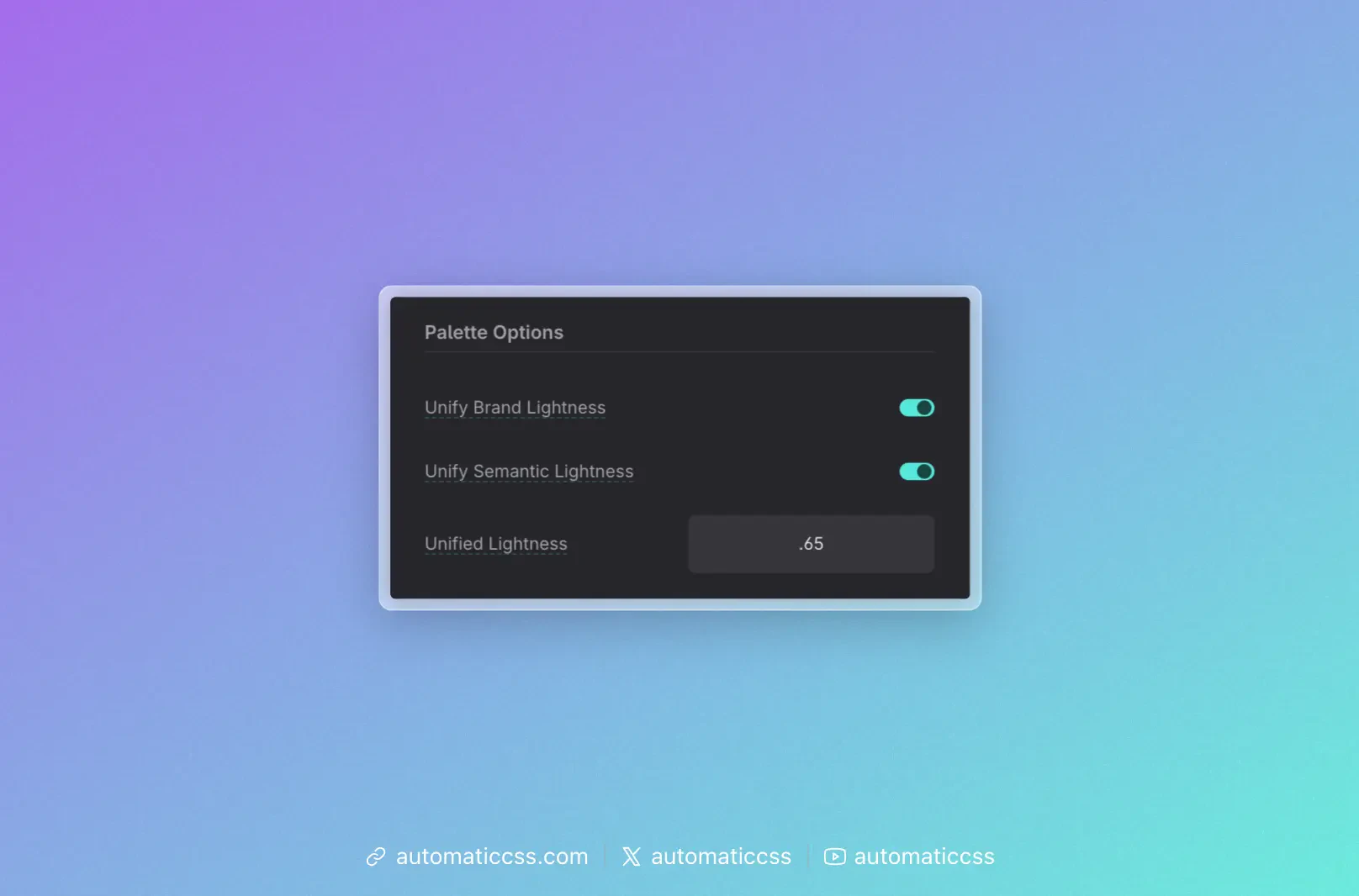
Settings
- Unify Brand Lightness – When on, the main (base) swatch of each main color (Primary, Secondary, Tertiary, Accent, Base) uses the Unified Lightness value for its OKLCH L channel. Hue and chroma stay from the color you set; only lightness is forced to the shared value. Shades (ultra-light, light, dark, etc.) keep their own lightness steps.
- Unify Semantic Lightness – When on, the base swatch of each semantic color (Success, Warning, Info, Danger) uses the same Unified Lightness value. Useful if you want status colors to match the perceived brightness of your brand colors.
- Unified Lightness – The shared lightness value (0–1). Default is 0.65 (65% in OKLCH). This field appears when at least one of the two toggles above is on. Lower = darker base swatch; higher = lighter.
When to use it
Keep it on (default) when you want one consistent “weight” for all base brand and/or semantic colors—e.g. for buttons, badges, or icons that should feel like they’re from the same family. You can still use the full shade scale (light, dark, ultra-dark, etc.) for backgrounds and text; only the base swatch is unified.
Turn it off when you want each color to keep its natural lightness (e.g. a darker Base and a brighter Primary). You get more variety, but less of a “single lightness” look.
Technical note
Unified Lightness only changes the L (lightness) of the base swatch in OKLCH. It does not change the generated shades (ultra-light through ultra-dark) or hover; those still use their own L values. So you get a unified “main” color across the palette while keeping the full shade scale for each.